
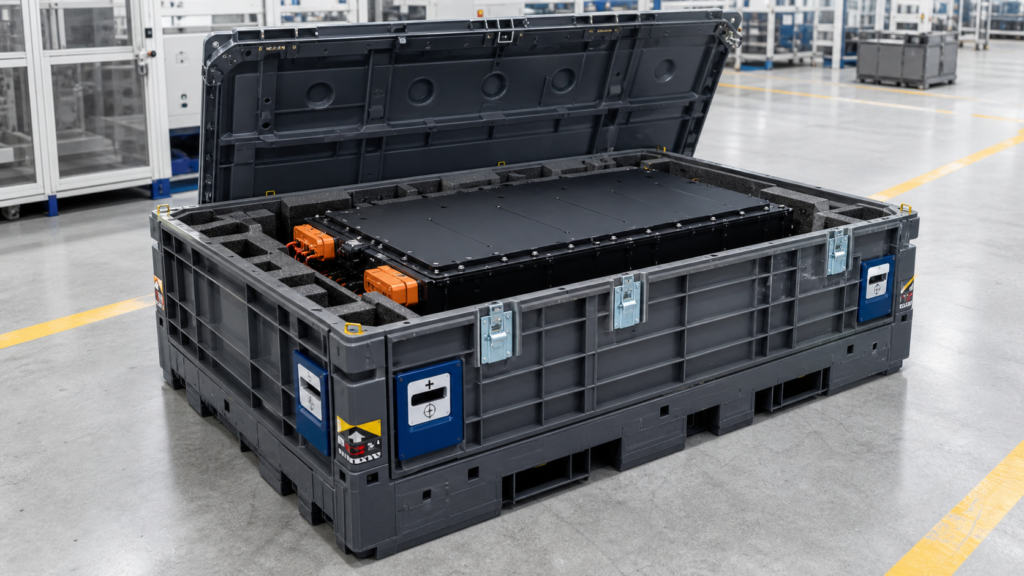

Returnable packaging for an industrial lithium battery pack is an engineered interface between the battery, factory, warehouse, vehicle, and customer site. Its job is broader than preventing scratches. A reusable crate must restrain a high-mass pack, protect terminals and connectors, preserve lifting access, survive repeated handling, and provide a clear inspection decision before every reuse.
It is also important to separate two questions. The first is whether a container is suitable for an internal closed-loop logistics process. The second is whether the complete package complies with the dangerous-goods rules for a particular transport mode, route, battery configuration, state of charge, and condition. A reusable factory container does not automatically become compliant dangerous-goods packaging.
This guide gives OEM buyers and battery suppliers a practical design and acceptance framework for returnable packaging used with forklift, AGV, special-vehicle, and stationary industrial lithium battery packs.
Define the logistics loop before designing the crate
Start with a route map, not a container sketch. Document every stage the packaging will experience:
-
battery-pack loading and closing at the manufacturing plant;
-
internal movement by forklift, pallet truck, crane, or conveyor;
-
warehouse stacking and dwell time;
-
road, sea, rail, or air transport where applicable;
-
unloading and movement at the customer site;
-
storage of the empty container;
-
return transport, cleaning, inspection, repair, and release for reuse.
For each stage, define the handler, equipment, orientation, maximum stack, environmental exposure, and expected number of cycles. A crate designed around one clean factory forklift may fail when a distributor uses shorter forks, handles the load from the side, stores it outdoors, or returns it with water and debris trapped in the dunnage.
The packaging drawing should identify the approved pack models and revision range. If several battery variants share one container, prove that each variant has a controlled support plane, restraint system, terminal clearance, center-of-gravity location, and closing envelope. Adjustable dunnage needs positive position identification so an operator cannot select the wrong configuration.
Build the load case from mass and center of gravity
Record battery mass, dimensions, center of gravity, approved lifting points, enclosure load limits, and prohibited contact zones. Do not assume the battery enclosure can carry packaging restraint loads at any convenient surface.
A basic restraint review should include forces in longitudinal, lateral, and vertical directions. The design basis may come from the selected transport test, customer specification, route study, or applicable regulation. Translate acceleration into restraint force with:
Restraint force = pack mass x design acceleration
For example, a 900-kilogram battery subjected to a 2 g longitudinal design event represents an inertial force of about 17.7 kilonewtons before applying project-specific factors. That force must travel through dunnage, fasteners, container walls, and base structure without moving the battery into connectors, service covers, or the lid.
The load path should be visible in the drawing. Use broad structural contact at approved zones rather than point loads on thin covers. Control vertical bounce as well as horizontal sliding. If straps are used, specify routing, pretension, edge protection, inspection criteria, and replacement limits. A strap that crosses a removable service cover or coolant fitting is not an acceptable restraint.
Prevent electrical contact and short circuits
Protect every exposed terminal against conductive tools, loose fasteners, damaged dunnage, and adjacent batteries. Terminal covers should remain installed during handling and should not rely on adhesive alone where repeated cycles, dust, oil, or temperature can reduce adhesion.
Connector protection should control three risks:
-
direct impact to pins or housings;
-
partial engagement with an unintended object;
-
contamination or moisture that creates tracking or corrosion.
Keep metal restraint hardware outside defined electrical clearance zones. Retain loose accessories in dedicated, closed compartments. Do not place cables, service plugs, bolts, or manuals on top of the battery unless the design includes a fixed holder that prevents movement.
The PHMSA Lithium Battery Guide for Shippers provides scenario-based guidance for packaging lithium cells and batteries under United States hazardous-material requirements. It should be used with the applicable regulations and competent dangerous-goods advice for the actual shipment. The guide does not turn a general returnable tote into compliant packaging by inspection alone.
Separate UN 38.3 evidence from package approval
UN 38.3 concerns transport testing and classification of lithium cell and battery types. It is necessary evidence for many shipments, but it is not a substitute for selecting the correct package, marks, labels, documents, state-of-charge controls, or mode-specific instructions.
The UNECE Manual of Tests and Criteria, Revision 8 and Amendment 1 is the authoritative source for the current UN test framework, including subsection 38.3. The buyer should request the test summary for the exact battery type and confirm model identity, manufacturer, laboratory, report reference, date, physical description, mass, watt-hour rating, tests, results, and signatory information.
The UN Model Regulations, Revision 24 provide the international model framework that national and modal rules implement. Actual shipment requirements depend on the jurisdiction and mode. Road, sea, rail, and air rules may differ, and damaged, defective, recalled, prototype, waste, or recycling batteries require separate review.
For additional transport-safety context, IEC 62281 addresses safety requirements and tests for lithium cells and batteries during transport. Always confirm which edition and amendments are required by the contract or applicable rule.
Design the reusable container as a controlled asset
A returnable container needs an identity and service history. Permanently mark or electronically identify each crate so the operator can retrieve:
-
container design and revision;
-
approved battery models and maximum mass;
-
manufacture date and supplier;
-
inspection status and next inspection requirement;
-
repair history and replaced parts;
-
cleaning status;
-
number of completed cycles when cycle tracking is required;
-
quarantine reason and disposition.
Do not use a generic green tag as the only release evidence. Inspection criteria should distinguish cosmetic damage from structural or safety damage. A cracked latch mount, distorted fork pocket, missing terminal shield, compressed dunnage, loose restraint anchor, chemical contamination, or unreadable identity label should trigger quarantine until evaluated.
Repairs must follow an approved method. Welding, drilling, plastic heat repair, substitute foam, and non-original latches can change load capacity, flammability, clearances, or closure performance. Define which repairs are permitted locally and which require return to the packaging supplier.
Create a packaging design verification matrix
The packaging specification should convert expected hazards into tests and measurable acceptance criteria.
| Verification item | Test or review | Example acceptance evidence |
| — | — | — |
| Battery fit | Dimensional and tolerance study | No interference at worst-case stack |
| Center of gravity | Loaded handling trial | Stable in all approved fork directions |
| Restraint | Static or dynamic load test | Movement within agreed limit; no damage |
| Shock and vibration | Route-based or specified laboratory profile | No contact, loosening, leakage, or functional damage |
| Stack | Compression test with aged containers | No unsafe deformation or loss of closure |
| Fork pockets | Entry and misuse-envelope test | No pack contact; visible fork-stop control |
| Terminal protection | Probe and loose-object review | Conductive access prevented |
| Water and dust | Exposure and drainage inspection | No trapped water at pack or dunnage |
| Repeated use | Cycle test including cleaning and handling | Latches, dunnage, labels, and restraints remain acceptable |
| Empty return | Nesting or stacking trial | Stable return load without component loss |
The test plan should state whether the battery is live, representative, instrumented, or simulated. A mass dummy can prove structure but may not represent connector fragility, enclosure stiffness, thermal interfaces, or internal component response. Correlate the dummy to a production-representative pack for critical tests.
Shock and vibration testing should reflect the route and restraint arrangement. Record container serial number, battery or dummy identity, mass, center of gravity, dunnage revision, closure torque or strap tension, instrumentation, test profile, photographs, and deviations.
Design forklift and lifting interfaces around real handling
Industrial battery packs are heavy. The OSHA powered-industrial-truck guidance notes the need for suitable material-handling equipment when lifting heavy batteries. Packaging should therefore make the correct handling method obvious and make foreseeable incorrect fork entry less likely.
Specify fork-pocket dimensions, entry direction, minimum fork length, fork-stop location, clearance below the battery, and maximum tine height. Test with the equipment used at both shipper and receiver. A pocket that works with one factory forklift may allow another truck's fork tips to strike the battery enclosure.
If crane lifting is permitted, identify certified lifting points and sling geometry. The crate lid, latch, or cosmetic frame should never be used as a lifting point unless specifically designed and rated for it. Mark the center of gravity where handlers need that information.
Control cleanliness, moisture, and return condition
Define acceptable contamination for battery-contact surfaces. Oil, metal chips, salt, conductive dust, damaged absorbent material, and trapped water can turn reusable packaging into a reliability risk.
The design should drain after washing and should not hide moisture against the pack. Select dunnage compatible with the cleaning process and expected temperature. If foam absorbs water or chemicals, include a replacement rule. Cleaning chemicals should not degrade plastics, labels, seals, flame-retardant properties, or anti-static performance where those characteristics matter.
Empty packaging should be closed or covered during return to prevent debris accumulation. Returned containers should enter a clearly separated inspection area, not move directly back to clean production.
OEM acceptance package
Before approving volume production, request:
-
packaging assembly drawing and bill of materials;
-
battery-to-packaging interface drawing with prohibited contact zones;
-
maximum gross mass, stacking limit, and approved handling methods;
-
material specifications and critical component controls;
-
design verification report and route-specific test evidence;
-
inspection, cleaning, repair, and quarantine instructions;
-
label artwork and container identification method;
-
change-control requirements;
-
dangerous-goods packaging evidence required for the intended routes;
-
pilot-shipment report from factory to customer and back.
Use a production-representative pilot. Inspect the battery and container at dispatch, receipt, empty return, and the next loading cycle. Record movement marks, loosened hardware, moisture, dunnage set, connector condition, label damage, and handling difficulties. A crate should not be approved only because the first outbound shipment arrived without obvious damage.
Related FISSION engineering resources include BMS hardware-in-the-loop fault testing, ESS rack maintenance isolation, and AGV battery blind-mate connector alignment.
Frequently asked questions
Can one reusable crate be used for several battery models?
Yes, but every model and revision must have an approved fit, restraint, center-of-gravity, terminal-protection, lifting, and closure configuration. Adjustable parts should be positively identified and protected against incorrect assembly.
Does UN 38.3 approval mean the reusable packaging is approved for shipping?
No. UN 38.3 addresses the battery type's transport tests and classification evidence. Packaging, marks, labels, documents, state of charge, route, transport mode, and battery condition must be evaluated separately under the applicable rules.
When should returnable battery packaging be quarantined?
Quarantine it when damage could affect structure, restraint, electrical protection, lifting, closure, cleanliness, traceability, or regulatory use. Examples include cracked fork pockets, distorted walls, missing terminal covers, compressed dunnage, loose anchors, contamination, unapproved repairs, or unreadable identity labels.
Contact FISSION Lithium
For custom industrial LiFePO4 battery packs, packaging-interface reviews, OEM documentation, samples, BMS integration, and project quotations, contact Zhejiang Feixiang Technology Co., Ltd.
Mr. Zhong
Phone / WhatsApp / WeChat: +86 18969667183
Email: [email protected]
Mr. Ying
Phone: +86 18657665923
Email: [email protected]
Website: https://www.zjfx-tech.com/