
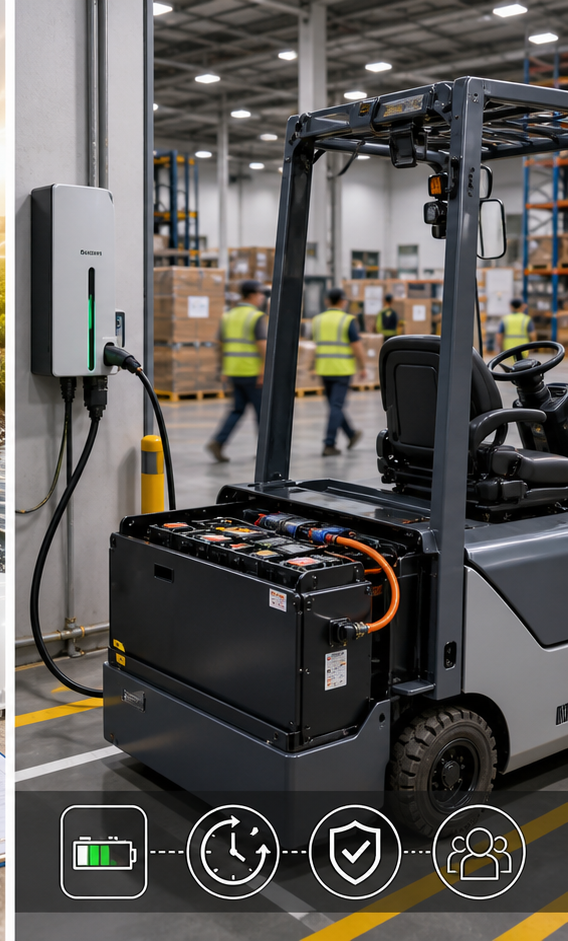
For a multi-shift warehouse, changing from lead-acid batteries to lithium forklift batteries is not only a battery replacement decision. It changes the charging workflow, spare battery planning, operator habits, charger placement, and the way uptime is measured. A lithium pack can reduce battery change time and support opportunity charging, but only when the charging strategy is designed before deployment.
The first planning question is how many shifts the fleet runs each day. A single-shift warehouse may charge batteries overnight and keep the process simple. A two-shift or three-shift operation needs a more detailed charging plan because trucks may have short breaks, staggered lunch periods, or continuous loading windows. Lithium batteries make this easier, but charger access must match the real operating rhythm.
Opportunity charging is one of the main advantages of LiFePO4 forklift batteries. Instead of removing a heavy lead-acid battery and replacing it with a spare, operators can plug in during breaks or idle windows. However, opportunity charging should be controlled by charger power, BMS limits, site wiring capacity, and battery temperature. Faster charging is useful only when it does not create unnecessary heat or grid-pressure problems.
Charger matching is therefore a core part of the procurement decision. Buyers should confirm battery voltage, capacity, recommended charge current, connector type, charger communication, and whether the charger needs CAN or other coordination with the BMS. A high-quality battery pack with the wrong charger can create downtime, alarms, or accelerated stress on the pack.
BMS communication is especially important in industrial forklift projects. A strong BMS should monitor cell voltage, pack current, temperature, state of charge, and protection events. For fleet operators, readable status and fault information help maintenance teams respond quickly. For OEM buyers and distributors, BMS compatibility with the target forklift model or charger system should be reviewed before mass delivery.
Charging location also affects safety and productivity. Warehouses should place chargers where forklifts naturally stop, but away from traffic bottlenecks and impact risk. Cable routing, ventilation, wall mounting, floor markings, and connector storage all matter. Lithium charging stations usually need less battery-room infrastructure than lead-acid systems, but they still require disciplined layout and operator training.
When calculating ROI, buyers should look beyond battery purchase price. A lithium forklift battery program may reduce spare batteries, battery changing labor, watering maintenance, acid handling, and downtime. The value is strongest in multi-shift warehouses where equipment utilization is high. The correct comparison is total operating cost, not only battery cost per unit.
A practical charging strategy includes: map the shift schedule, identify natural charging windows, size chargers for the available break time, confirm electrical infrastructure, match charger communication with the BMS, train operators, and review charging data after deployment. This turns lithium battery adoption into an operating system, not only a hardware purchase.
Related FISSION reading: Lead-Acid vs Lithium Forklift Battery ROI Analysis at https://www.zjfx-tech.com/post/lead-acid-vs-lithium-forklift-battery-roi-analysis and Industrial LiFePO4 Battery Pack Safety Checklist for OEM Buyers at https://www.zjfx-tech.com/post/industrial-lifepo4-battery-pack-safety-checklist-for-oem-buyers .
Contact FISSION for lithium forklift battery, LiFePO4 battery pack, and industrial OEM project inquiries: Phone/WhatsApp/WeChat +86 18969667183, Tel +86 18657665923. Address: 3rd Floor, Building 2, No. 98 Juye Road, Haimen Subdistrict, Jiaojiang District, Taizhou City, Zhejiang Province.