
Forklift Lithium Battery Opportunity Charging Schedule for Multi-Shift Warehouses is a practical engineering and procurement issue for warehouse fleet managers, material-handling dealers, operations engineers, and battery buyers. Opportunity charging can eliminate battery changes, but unplanned short charges may create charger queues, high peak demand, thermal stress, or insufficient state of charge late in the shift.
This guide explains how to evaluate forklift lithium battery opportunity charging without reducing the decision to one catalog number. The objective is a system that performs predictably in the real installation, can be inspected and serviced, and gives the buyer clear acceptance criteria before mass production or project shipment.
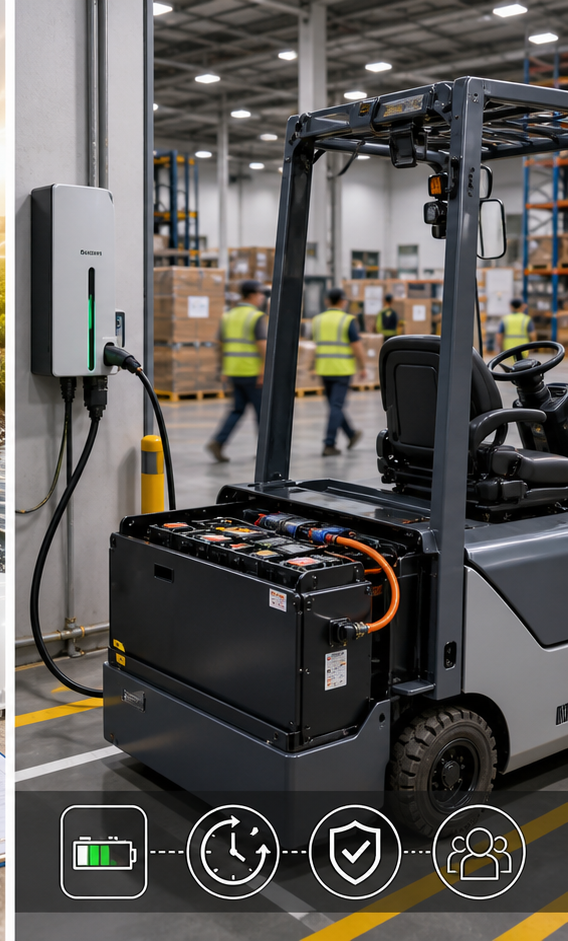
Why forklift lithium battery opportunity charging matters
Build the schedule from energy consumed per operating hour, shift intensity, break duration, charger power, battery charge acceptance, temperature, and required reserve. This operating logic should be documented before product selection because the same nominal component can behave differently after installation geometry, wiring, hydraulic conditions, ambient temperature, and duty cycle are applied.
The battery, BMS, charger, connectors, and fleet workflow must be designed together. Telematics data should validate state-of-charge windows and identify vehicles that need different pack or charger sizes. For B2B projects, these decisions affect not only first cost but also commissioning time, warranty exposure, spare-parts planning, and the ability of local technicians to diagnose a fault without replacing the complete system.
The intended applications include 24/7 warehouses, cold storage, distribution centers, manufacturing plants, and Class 1-3 forklift fleets. Each application should be converted into measurable duty conditions so that supplier quotations can be compared on the same basis.
Technical parameters to define before ordering
A useful inquiry does more than request price and delivery time. It defines the duty point, environment, interfaces, protection philosophy, and verification method. The following parameters should appear in the technical schedule or approved sample record:
-
Measured kWh consumption per truck and shift
-
Available charging minutes during breaks and changeovers
-
Charger current, connector rating, and facility demand limit
-
Battery SOC window, charge temperature, and thermal limits
-
Fleet utilization, charger-to-truck ratio, and queue risk
Where a value is unknown, state the assumption and ask the supplier to confirm its effect. This is safer than leaving a blank field that may be filled with a default construction unsuitable for the project. Critical ratings should be supported by model-specific drawings, test conditions, and revision-controlled documents.
Selection and commissioning checklist
Use the following sequence to move from inquiry to a repeatable installation. It is designed for distributors and OEMs that need consistent results across multiple shipments, installers, or customer sites:
-
Collect duty-cycle data before sizing
-
Model the worst shift rather than fleet average
-
Reserve charging positions near operating zones
-
Set BMS and charger limits as an approved pair
-
Review telematics after commissioning and adjust schedules
During commissioning, record the final settings, measured operating values, wiring or piping arrangement, and any deviation from the approved design. These records create a baseline for troubleshooting and make future replacement orders much more accurate.
Common mistakes and how to prevent them
Many field complaints start with a mismatch between the published rating and the actual system condition. The following errors are common because they may not appear during a quick bench test:
-
Buying one pack size for every truck
-
Assuming every break becomes usable charge time
-
Ignoring cold-battery charge limits
-
Sizing charger quantity without queue analysis
-
Running packs to emergency low SOC every shift
Prevention is usually inexpensive when it is built into the inquiry, sample approval, and installation drawing. After mass production or site commissioning, the same correction can require rewiring, new mounting hardware, replacement stock, or a difficult warranty discussion.
B2B procurement and quality-control guidance
For an OEM or distribution order, request a complete technical package: product drawing, bill-of-material controls for critical parts, electrical or hydraulic ratings, environmental limits, installation instructions, packaging specification, labels, test evidence, and change-control terms. The commercial quotation should identify every option that affects performance rather than hiding it under one model name.
Approve representative samples under the intended load and environment. Then define incoming inspection for each lot, including identity, dimensions, markings, basic function, and risk-based performance tests. If the supplier changes a critical material, firmware version, cable, connector, seal, cell, controller, or internal switching component, written reapproval should be required before shipment.
Frequently asked questions
Does LiFePO4 need a full charge each day?
Not necessarily. Partial charging is practical, but operations should maintain an SOC window that supports the full duty cycle and balancing strategy.
How many chargers are required?
Use fleet arrival patterns, charge duration, utilization, and redundancy. A simple truck-to-charger ratio can hide simultaneous demand.
Can the existing lead-acid charger be used?
Only if voltage, current, charge profile, communication, safety interlocks, and connector design are compatible with the lithium battery supplier's approval.
Related technical guides
Continue with our guide to custom battery BMS communication protocols.
You may also review our article on LiFePO4 battery testing documents.
You may also review our article on battery swapping cabinet safety design.
Contact FISSION
For model selection, OEM requirements, drawings, samples, and project quotations, contact our team with the application, target specifications, required quantity, destination market, and expected delivery schedule.
Phone / WhatsApp / WeChat: +86 18969667183. Tel: +86 18657665923. Website: https://www.zjfx-tech.com/